Needfinding
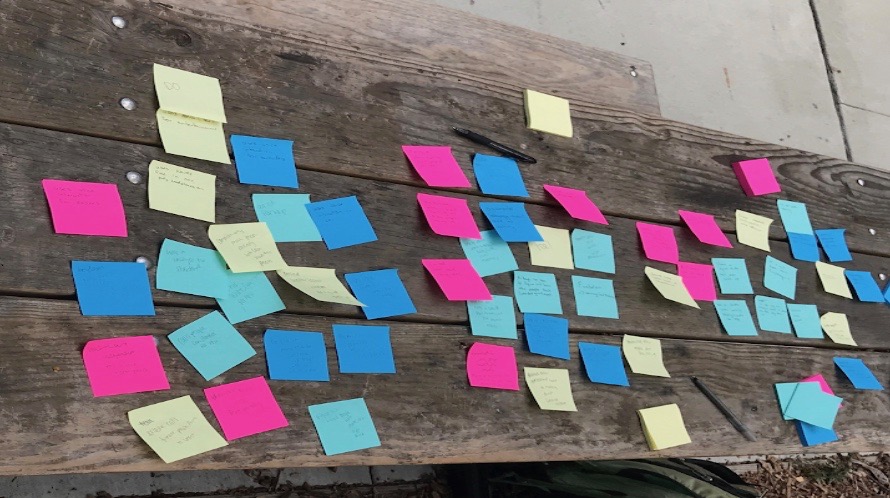
We conducted the first needfinding round for our project by interviewing 3 people and generating empathy maps based on their responses.
Check out our map and slides below!
Points of View and Experience Prototypes

We furthered our needfinding research by conducting 3 more interviews.
With this deepened understanding of potential user needs, we translated our findings into points of view (POVs) and how might we (HMW) statements.
Armed with this new understanding, we created experience prototypes to test our assumptions.
Check out our report and slides below!
Thundr Concept Video
We distilled what we learned from needfinding and identified a problem: people want a better brainstorming tool that allows remote participation, too.
We were starting to narrow in on a problem, and we had some great ideas for how to solve it.
Check out our slides below!
Low-Fi Prototype
After we felt confident we had a good idea in mind, we started sketching.
We took a stab at many different formats and implementations, using rapid prototyping to see which one made the most sense.
Check out our report and slides below!
Medium-Fi Prototype
We decided to build Thundr for mobile, giving users the freedom to move around while brainstorming and use their phones to register ideas.
We got to work designing mock ups, using Marvel and Adobe XD.
Check out our readme and slides below!
Heuristic Evaluation
After building our medium-fi prototype, we handed it over to another team so they could conduct a heuristic evaluation on it.
Our goal was to get some fresh sets of eyes on Thundr, to help us identify any parts of the medium-fi prototype that were confusing or poorly designed.
Check out the results of the evaluation below!
High-Fi Prototype
After receiving our heuristic evaluation feedback, we went back to the drawing board.
After some extensive prototyping on Adobe XD, we settled on a new color scheme and task flow and set to work building it using React Native.
Try downloading the app to your phone below!
Poster and Pitch Slide
After a quarter long of work, we had a working hi-fi prototype that we were proud of.
Check out our pitch slide and posterboard below!