Adam Cheyer
SRI International
Tasking Communities of Agents Through Adaptable Multimodal Interfaces
May 28, 1999
In today's computing environments, people interact with programs,
web sites, devices, and other computational resources individually,
one at a time. However, as multitudes of software agents begin
populating our netspace, the predominant interface paradigm may
shift towards a more delegation-based style, with the user saying:
"Here's what I want to do, you programs figure out who needs
to be involved."
Within the context of a distributed framework called the Open
Agent Architecture (OAA) , we have been exploring ways in which
interactions among software components can be made flexible and
cooperative. Simultaneously, we are looking at new user interface
(UI) approaches for interacting with our evolving communities
of agents (programs). Some of the UI qualities we're most interested
in include:
Dynamic: As new agents join or leave the community,
what the user can say and do changes. Users may interact with
individual applications or specify complex tasks that involve
many automated participants.
Adaptable display: A user should be able to access
the same set of agent capabilities from any class of interface
environment, ranging from the richness of immersive 3D environments,
to standard HTML browsers, all the way down to a simple telephone
or 2-way pager. Presentation of results must adapt accordingly.
Multimodal: When a professor at a blackboard communicates
with a classroom of students, information is conveyed through
simultaneous combinations of drawing, writing, speaking and gesturing.
Tasking a community of software agents should be as easy.
Multi-user Collaborative: Agents cooperate with each
other when solving tasks. The human-agent interaction framework
should also enable multiple users to work with each other and
with agents in the same workspace.
Social: Once agent systems begin to accept naturally
expressed requests from one or more users, this opens the possibility
for agents to take on a more lifelike presence. How will the
use of avatars and improved dialog capabilities change user-agent
interactions?
Our progress and thoughts in these areas will be illustrated
through examples and demonstrations taken from several OAA-based
applications.
|
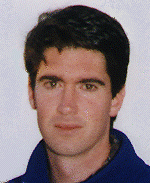
Adam Cheyer is
a computer scientist at SRI International 's Artificial
Intelligence Center, and is co-director of SRI's Computer
Human Interaction Center (CHIC!). |
|