Norbert Streitz
GMD - German National Research Center for Information Technology, IPSI - Integrated Publication and Information Systems Institute Darmstadt, Germany
Roomware: Towards the next Generation of Human-Computer Interaction based on an Integrated Design of Real and Virtual Worlds
May 21, 1999
In this talk, I will report about our new ideas on extending
the scope of human-computer interaction and cooperation support
not only from desktops to meeting room scenarios as we did in
the past but taking a more comprehensive perspective resulting
in highly flexible and dynamic work environments. This perspective
is provided by the notion of "cooperative buildings"
which addresses the issues of how to integrate information technology,
new work practices resulting from organisational innovation,
and the physical environment, the architectural structures and
facility management. Our approach incorporates also ideas from
augmented reality and ubiquitous computing resulted in the view
that the world around us is the interface. In order to illustrate
this, we have developed i-LAND: an interactive landscape for
creativity and innovation. i-LAND integrates several so-called
"roomware" components into a combination of real, architectural
as well as virtual, digital work environments for creative teams.
By "roomware", we mean computer-augmented objects in
rooms, like furniture, doors, walls, and others. The current
realization of i-LAND covers an interactive electronic wall (DynaWall),
an interactive table (InteracTable), two versions of computer-enhanced
chairs (CommChairs). Furthermore, we developed "Passage",
a mechanism for connecting information structures in the virtual
information world with real world objects allowing also for physical
transportation of digital information. More components are planned.
i-LAND is an example application of our vision of the Workspaces of the
Future. At the same time, it is a testbed for developing
new forms of human-computer interaction and computer-supported
cooperative work.
Selected References:
Streitz, N.A., Geißler, J., Holmer, T. (1998). Roomware
for Cooperative Buildings: Integrated Design of Architectural
Spaces and Information Spaces. In Streitz, N.A., Konomi, S.,
Burkhardt, H.-J. (Eds.): Cooperative Buildings. Integrating
Information, Organization, and Architecture. Springer LNCS
1370, 1998, 4-21.
Streitz, N., Geißler, J., Holmer, T., Konomi, S., Müller-Tomfelde,
C., Reischl, W., Rexroth, P., Seitz, P., and Steinmetz, R. (1999).
i-LAND: An interactive Landscape for Creativitiy and Innovation.
To appear in: CHI '99 Print Proceedings and CHI'99
Video Proceedings
|
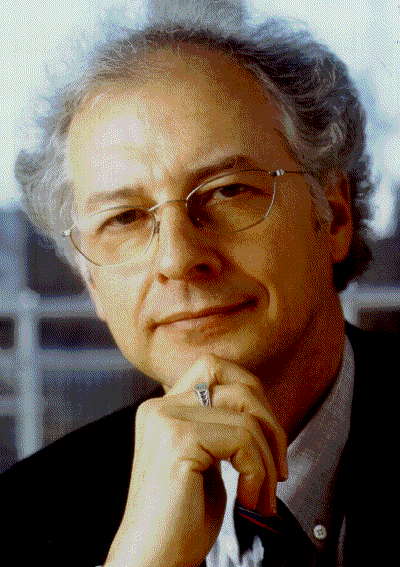
Dr. Dr. Norbert
A. Streitz (Ph.D. in physics, Ph.D. in psychology) is currently
the manager of the new research division "AMBIENTE
- Workspaces of the Future" of the Integrated Publication
and Information Systems Institute (IPSI)
in Darmstadt. He was also the Deputy Director of IPSI (1992-1998)
and the manager of the research division "Cooperative Hypermedia
Systems" (1991-1997), before he initiated the new research
division in 1997 which is now under his direction.
IPSI has about 100 employees and is one of the eight research
institutes of the German National Research Center for Information
Technology (GMD) which has a total of about 1100 employees. Norbert
Streitz teaches also at the Department of Computer Science of
the Technical University Darmstadt. He has edited 12 books and
published more than 70 technical publications. He is an associate
editor of the journal ACM Transactions on Information Systems
(TOIS) and a regular member of the program committees of the
relevant national and international conferences in Hypermedia,
Human-Computer Interaction, and CSCW. He is often asked to present
seminars and tutorials, invited talks and keynote speeches in
Europe, the US, and Japan. His general research activities include
hypertext and hypermedia, human-computer interaction, computer-supported
cooperative work (CSCW), and more recently augmented reality
and ubiquitous computing. The latter results from his current
activities where he is concerned with the relationship between
new ways of organizing work, characteristics of information and
communication technology and their implications for the design
of innovative work and learning environments including the architectural
structures of "cooperative buildings". |
|