Lucy Suchman
Xerox PARC
Putting Working Document Collections Online
January 15, 1999
The Carquinez Bridge Replacement Project is a civil engineering
initiative within the California Department of Transportation
(Caltrans), charged with the design of a replacement bridge over
the Carquinez Straits at the north end of the San Francisco Bay.
For the past two years I and my colleagues in the Work Practice
& Technology area at Xerox PARC have been engaged in a collaborative
research effort with engineers in the Carquinez Project group,
focussed on a collection of documents called the engineering
project files. Together we're exploring what it would mean to
create an electronic version of the files, currently maintained
on paper in three ring binders.
The project files are an instance of what we've termed working
document collections, occupying a niche between the active documents
on one's desktop and those stored in an archive. Project files
are maintained by every project team at Caltrans, and comprise
a kind of cumulative documentary record of a given engineering
project. The documents in the files are extremely heterogeneous,
ranging from standard business correspondence to quite specialized
charts, maps and other exhibits tied to the particular requirements
of civil engineering. Documents are filed according to the Caltrans
Uniform Filing System, a hierarchically arranged set of categories
designed roughly to map the chronological course of a project.
Our intervention is aimed at defining the work practice and technology
requirements for migrating the project files from paper to digital
media, integrated with Caltrans' developing intranet. Our approach
is to require minimal overhead for putting documents into the
collection, while providing opportunities for arbitrarily extensible,
iterative, and modifiable document coding, and multiple strategies
for document retrieval.
In this talk I'll describe the particular interests of the
project files, of working document collections, and of our current
project as part of an ongoing research agenda in work-oriented
design.
|
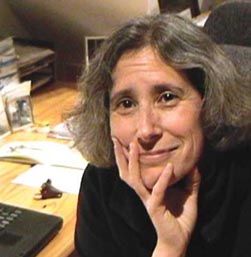
Lucy Suchman received a Ph.D. in Social/Cultural Anthropology
from the University of California at Berkeley in 1984. Since
1979 she has been a researcher at Xerox Palo Alto Research Center,
where she is currently a Principal Scientist and head the Work
Practice and Technology area, a multidisciplinary research group.
In addition to her position at Xerox PARC, she am an affiliate
researcher at the Center for the Study of Language and Information
at Stanford University and at the Institute for Research on Learning
in Palo Alto, as well as a Consulting Associate Professor in
Stanford University's Symbolic Systems Program. She served as
Program Chair for the Second Conference on Computer-Supported
Cooperative Work in 1988, and for the first Conference on Participatory
Design of Computer Systems in 1990. She was a founding member
of Computer Professionals for Social Responsibility and served
on its Board of Directors from 1982-1990. Her dissertation Plans
and Situated Actions: the problem of human-machine communication
was published by Cambridge University Press in 1987. It provides
a critical analysis of models of human action and communication
that underlie the design of interactive machines, and proposes
an alternative perspective drawn from recent developments in
the social sciences. Her current research concerns the relation
of ethnographies of everyday practice to new technology design. |
|