Miriam Reiner
Department of Education In Science and Technology, Technion - Israel Institute of Technology
Access to tacit embodied knowledge: Force sensations and conceptualization
December 4, 1998
Bodily acts are often tacit, implicit, and are hard or impossible
to capture in propositional form. Yet some highly sophisticated
knowledge is evidenced in the dynamics of the body. For instance
in learning how to play tennis, even a novice tennis player is
capable of raising a hand accurately to meet the approaching
ball without necessarily being familiar with the rules of trajectile
motion. Asking players how they know what acts are needed to
accomplish this task, is unlikely to elicit a good propositional
description. What then, is the mechanism by which the player
knows how to act? How is this knowledge related to conceptual
learning?
This talk deals with the interaction between tacit, non-propositional
knowledge, evidenced in the dynamics of the body, and symbolic
knowledge. Basically it will describe how cognitive knowledge
arises from bodily accumulated experience, such as force sensations
that are involved in problem solving in surgery, in learning
physics at the lab and in many other domains. In particular,
it will describe how tacit knowledge, of which learners are normally
not aware, and which is triggered unconsciously by sensations
of force patterns, can be accessed and exploited to improve learning
and training and to design force-feedback interfaces for virtual
environments and for the Web.
Three studies will be reported.
Using force sensations for pattern recognition of force-fields
and invisible objects; Recognition of objects as a process of
mental construction of naive force-fields. The study was carried
out with the Phillips tactile interface
Basic 'force-sensation-elements' that evoke conceptual meaning;
Carried out on the SRI Int. tele-presence system.
Features of force-sensation-patterns that are necessary for
them to carry meaning ( or: why some force-sensation-patterns
carry meaning and some do not?)
The results of the studies show that force feedback interfaces
are a gate to tacit embodied knowledge, otherwise unavailable
for symbolic learning. Results also show that particular force
sensations constitute a primitive type of communication system,
non-propositional in its nature, that allows meaning construction.
Learners construct meaning of motor experience on the basis of
structures of embodied schemata of a figurative, dynamic, non-propositional
character. Furthermore, learners used such types of knowledge
to construct patterns and solve problems based on a non-propositional
knowledge. Implications to design of interfaces, virtual learning
environments and training in manual-conceptual domains such as
surgery will be discussed.
|
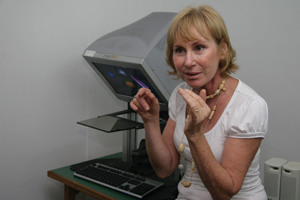
Miriam Reiner is a senior lecturer in the Technion-Israel
Institute of Technology. Director of, "Tomorrow 98"
in the Upper Galilee - A Model for Improving learning in science
and technology. Works with "Logitech" on a cognitive
design of force interfaces. Head of group: Cognitive issues in
haptic interface design.
She is interested in the interaction between tacit, non-propositional
knowledge and symbolic knowledge. Her recent research is focused
on how tacit knowledge, of which learners are normally not aware,
can be accessed and exploited to improve learning and training.
The basic assumption is that particular force patterns trigger
a particular meaning. Identifying the elements of such force
patterns, the inter-relations of visual-haptic sensations, and
implications for interface design are the current studies in
her group. |
|