Barbara Hayes Roth
Stanford Knowledge Systems Laboratory
Directed Improvisation by Computer Characters
February 3, 1995
"Directed improvisation" is a paradigm for human-computer
interaction. Directors (who may be human users or other computer
programs) guide the behavior of computer characters with abstract
instructions that establish skeletal narrative structures and
weak constraints on the desired behaviors. The characters work
together to improvise a course of behavior that conforms to the
structure, meets the constraints, and achieves other performance
objectives. Thus, characters follow directions, but may also
enhance performance, while surprising and engaging users with
their improvisations along the way.
Directed improvisation is similar in spirit to previous work
on instructable agents, multi-agent systems, advanced programming
languages, and object-oriented simulation. Following this earlier
work, directed improvisation aims to employ more abstract directions
to guide more discretionary behavior by more complete computer
characters.
We believe that computer characters capable of performing
directed improvisation will be useful elements of diverse applications,
especially applications in education, the arts, and entertainment.
We are developing a technology that combines a supporting agent
architecture with configurable components to facilitate efficient
and economical development of a variety of specific characters
for different applications. Our approach incoporates media-independent
interfaces, so that a given character's "mind" can
be embodied in animation, virutal reality, text, or other media.
Our current testbed application is a "virtual theater,"
in which animated characters take direction to improvise episodes
of physical and verbal behaviors. To be effective, the characters
also must exhibit simple intelligence, life-like qualities, and
improvisational expertise. Within the virtual theater, we conceive
several specific modes of interaction: animated puppets, animated
actors, collaborative playcrafting, improv troupe, improv direction,
and interactive story. In all of these modes, directed improvisation
offers users (in our case, children) the combined pleasures of
directing the creation, re-telling, or re-experiencing of a story,
while being delighted by the characters' unpredictable improvisations
within the story structure. In addition to its use as an experimental
testbed, the virtual theater is a promising paradigm for several
kinds of commercial applications: experience-based learning environments,
new kinds of computer games, a new medium for artistic self-expression,
or a new form for interactive story experience.
|
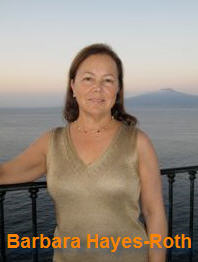
Barbara Hayes-Roth has been Senior Research Scientist in Computer
Science at Stanford since 1982. Previously, she was Senior Computer
Scientist at the Rand Corporation and Member of Technical Staff
at Bell Laboratories. She holds BA (1971, Boston University),
MS (1973, University of Michigan), and PhD (1974, University
of Michigan) degrees in Cognitive Psycholgy. Dr. Hayes-Roth developed
the "dynamic control architecture" (embodied in the
BB1 software), which supports the development of computer agents
that explicitly reason about, plan, and control their own behavior
in response to run-time conditions. Dr. Hayes-Roth has collaborated
with domain experts to develop experimental agents for: modeling
protein structures, designing construction site layouts, monitoring
medical patients, monitoring plant control and manufacturing
equipment, controlling autonomous robots, and more recently,
controlling improvisational computer characters. She has published
over 100 scientific articles and is a former Councillor, current
Conference Chair, and a Fellow of the AAAI. |
|