Genevieve Bell
Intel
The Digital and the Divine: a Critical Exploration of the Intersections of Spiritual Practice and New Technologies
November 11, 2005
The Australian Bible Society has recently produced a copy of the bible in
text message style and format -- it is designed to be loaded on a computer
and blue-toothed to a compatible cell phone and then broadcast to one's bible
study or Christian youth group. At first blush, this seems like an odd artefact,
the first line to a joke. But in the "West", there is a long and
complicated relationship between technology and religion. After all, Johannes
Gutenberg's printing press produced the Bible in the 1450s. It was the first
book to be thusly mass-produced. Today, the largest online genealogical service
is run by a Christian institution, the Catholic church has its own text message
service, religiously inspired blogs and chat rooms flourish in the United
States and elsewhere around the world. Elsewhere, technology manufacturers
are catering to the ways in which computational devices might support religious
practices, producing religion-specific technologies and experiences.
Indeed given the ways in which religious practices are intimately woven into
the fabric of daily life in many parts of the world, it should not be so far
fetched to imagine that new information and communication technologies (ICTs)
might support a range of non-secular activities.
Indeed, recent surveys of internet habits, corporate marketing strategies,
and new product developments, all point to the fact that there is a growing
(perhaps already grown) segment of the population that uses technology to
support religious practices. Yet, for the most part, however, religious or
spiritual uses of ICTs seem to exist in the realm of technological oddities,
fodder for offbeat columns and stand-up comics. Indeed, the critical literature
is surprisingly sparse on this subject.
In this talk, I want to revisit some of these instances of techno-fied spirituality,
with an ethnographic sensibility. I want to survey some of the existing practices
and devices, both in the mobile and internet spaces -- I am interested in
both institutional and individual strategies around these various computational
platforms and devices. I am particularly interested in thinking about the
ways in which religious uses of technology suggest a very different path(s)
for technology envisioning and development.
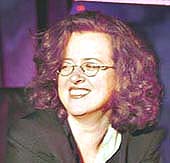
Genevieve
Bell is a Senior Researcher within Intel Corporation's Intel Research. Since
joining Intel in 1998, Bell has conducted ethnographic research in a variety
of consumer spaces, including malls, retail districts, and museums, as well
as within a range of different American households. Bell has also conducted
significant research beyond the US, including a five-country, strategically
situated, ethnographic study of European domestic spaces and a 2 year research
project focused on gaining a better understanding of the daily life of Asia's
urban middle classes, with an emphasis on the role of new information and communication
technologies. Prior to joining Intel, Bell taught anthropology and Native American
Studies at Stanford University. Bell received her BA/MA in anthropology from
Bryn Mawr College in Pennsylvania. She earned a PhD in cultural anthropology
from Stanford University in 1998. |
| |