Phoebe Sengers & Kaiton Williams
Cornell University & Impact America Fund
Speculation and the Design of Development
October 29, 2021
How do we make futures from the margins? In HCI, speculation is often framed as a tactic for expert designers from the global North to open new spaces for innovation. In this work, we ask how our understandings of speculation shift if we consider its progenitors to be those on the postcolonial periphery. Drawing on postcolonial anthropology and research through design, we analyze two historical cases of technology-infused development projects in Jamaica and in the Canadian province of Newfoundland and Labrador. The political leadership of both these British ex-colonies invested heavily in state-sponsored projects that leveraged technological imaginaries to envision modern futures as developed states. These imaginaries were bold, risky, and never realized. Viewing these projects as forms of vernacular speculative design, we find that speculation in these contexts is simultaneously constrained by, drawing on, and breaking out of imaginations of technological innovation arising from the global North. We will explore the implications of these perspectives for using speculation for the benefit of historically marginalized Black communities in the US.
|
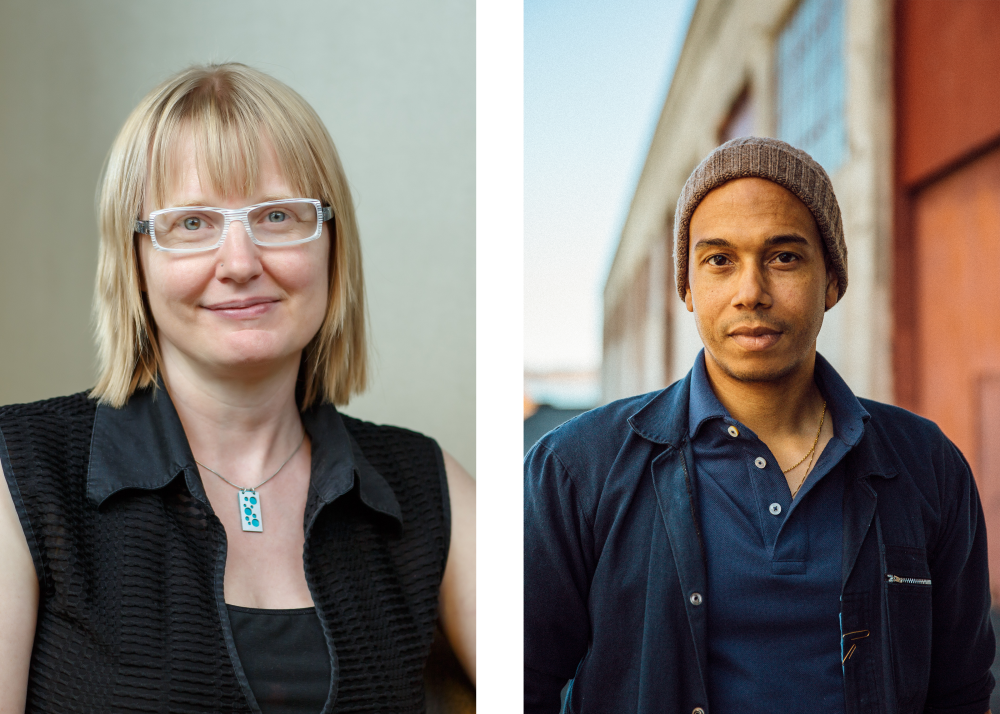
Phoebe Sengers (left photo) is an associate professor in Information Science and Science & Technology Studies at Cornell University. Her work integrates ethnographic and historical analysis of the social implications of technology with design methods to suggest alternative future possibilities. Her group explores rural, working-class and global South experiences of technologies, traces the emerging entanglements between people and data, and uses design to speculate about alternative pasts and futures. At Cornell, she leads the Culturally Embedded Computing group. She led the Cornell campus of the Intel Science & Technology Center for Social Computing, has been a Fulbright Fellow, a Fellow in the Cornell Society for the Humanities, and a Public Voices Fellow, and received an NSF CAREER award. She holds an interdisciplinary PhD in Artificial Intelligence and Cultural Theory from Carnegie Mellon University. Kaiton Williams (right photo) is the "Cultural Technologist" and Director of Research at Impact America Fund, a social impact venture capital firm focused on investments that help increase the economic agency and power of low income communities of color in the US. At the fund, he's particularly focused on the opportunities and challenges in connecting community-oriented design research with early stage tech entrepreneurship. Kaiton earned his Ph.D. in Information Science from Cornell University in 2017, where his ethnographic research focused on the experiences of tech entrepreneurs building products for and from communities outside of Silicon Valley's "normal." He also held senior engineering and architecture roles at Microsoft for over a decade, where he helped build and manage early web applications for over a billion users, and received his B.Sc. in Electrical and Computer Engineering from Morgan State University. |
|