Saadi Lahlou
EDF
Back from the office of the future: Lessons learned for the design of augmented environments
April 7, 2006
In 2000, the Laboratory of Design for Cognition at EDF R&D (a 50 billion
euro electricity utility, mainly nuclear, with 150 000 staff including over
60 000 office workers) constructed a living laboratory to observe white collar
practice and to design "augmented environments" for more comfortable
work experience and increased efficiency. Addressing the "cognitive overflow
syndrome" which was our main organisational target.
The K1 building is a 4000 sq ft "observation box" with flexible
infrastructure where observation systems monitor volunteer users who use the
space for their ordinary activity in the long run. The idea was to create
and support a full-scale "office of the future", inhabited by real
users for real work ("experimental reality"), see what happens,
and design solutions to the emergent problems.
The main experiment involved participative design with a project team of
20 engineers who had their workstations in the K1 and were observed continuously
for 3 years using an advanced ICT environment.
Eg. We videotaped over 100 meetings of this group, time-lapse videoed the
space for the whole period, subjects recorded daily activity with head-mounted
miniature video cameras (subcam) etc. International collaboration (Aaron Cicourel
-UCSD-, Valery Nosulenko -Russian Academy of Science-, Norbert Streitz -Fraunhofer-
…) enabled testing various theories and methods on the field.
This project produced and tuned several operational systems, some of which
are now used in the company. For instance we came out with a "killer-ap"
for synchronous distributed collaboration, and with a method that works for
disseminating technical innovation within the organization.
The experiments in this unique setting also produced constructive design failures,
and yield many methodological and theoretical results, e.g. about observation
biases.
This talk will present and discuss aspects of this work, and more specifically
the lessons learned for design.
I'll describe our setting of "experimental reality" for participative
design, with the observation techniques especially the subcam, -including
the novel strategy which we used to deal with the substantial amount of data
gathered. Our design principles and approach with be illustrated by some collaboration
systems we produced and our method for viral deployment in the company.
|
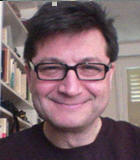
Saadi Lahlou is Head, Laboratory of Design for Cognition, Electricité
de France R & D/ SINETICS dept. He graduated as Statistician Economist
at ENSAE (Paris; 1983) and obtained his PhD in Social Psychology under supervision
of Serge Moscovici at Ecole des Hautes Etudes en Sciences Sociales, Paris.
He also holds degrees in Human Biology and Ethology.
After studying facial mimics of newborns in the CNRS-INSERM research unit
of Michel Jouvet, he joined the CREDOC (Research Center for Lifestyles and
Social Policies, Paris) where he directed the Consumer Forecasting Department
from 1987 to 1993. There he set up large statistical observation instruments
(such as the Observatoire des Consommations Alimentaires, now part of Agence
Française pour la Sécurité Sanitaire des Aliments), contributed
to the development of automated text analysis and to the application of multivariate
analysis methods to behavioral and cultural studies. He then joined EDF R&D
where was head of the Internal Social Forecast Group (1993-1998), head of
Cognitive Studies (1998-2000), then head of the Laboratory of Design for Cognition.
There he conducted organizational studies, developed video observation techniques
and design approaches. He is currently in charge of strategic forecast in
the ICT domain for the EDF R&D executive board.
Saadi Lahlou is also associate Directeur de Recherches CNRS at the Center
for Transdisciplinary Studies (EHESS/CETSAH), and Directeur Scientifique in
charge of the"Cognitive Technologies" Programme at Fondation Maison
des Sciences de l'Homme (Paris). He is founder and coordinator of the RUFAE
network (Research on User-Friendly Augmented Environments: www.rufae.net).
He has published in the areas of social psychology, survey and forecast methods,
lexical analysis, consumer behaviour and cognition. |
|