Charles Jorgensen
NASA Ames
Subvocal Speech and the Development of Biological Interfaces
February 17, 2006
Since 1999 NASA Ames Research Center has been involved in a research program
to enhance user machine interfaces through direct neurological signal recognition.
In 2000 we demonstrated how our first interfaces could replace aircraft joysticks
and numeric keypads in user dependant small scale tasks. In 2004 our emphasis
moved to the non invasive, non acoustic detection of speech from small electromyographic
signals (EMG) recorded at the lingual and larynx areas of the throat. Called
subvocal speech, this technology is showing promise for a number of new and
interesting application domains. This presentation will discuss how our results
were obtained and present recent progress with first responders, silent cell
phones, and augmentation of handicapped speech capabilities. Current extension
to continuous speech and remaining research challenges will be discussed.
|
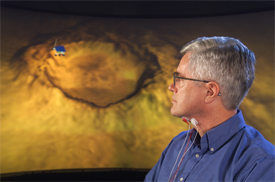
Dr. Jorgensen received his Ph.D. in Mathematical Psychology from the University
of Colorado Boulder in 1973. He has worked in academia, industry, and government
including Carnegie Mellon, the US Army Research Institute, Martin Marietta,
and Oak Ridge National Laboratories. He has been with NASA Ames Research Center
since 1990 and is presently Chief Scientist of the NASA Neuro Engineering
Laboratory.
Dr. Jorgensen has over 150 publications and seven patents in aeronautics,
neural engineering, and robotics. He is the recipient of numerous awards from
the American Nuclear Society and the Department of Defense as well as the
NASA Outstanding Engineering Achievement Medal in 1995 for neural network
controllers, NASA Exceptional Achievement medal for his work in Aeronautics
in 1998, and the NASA Exceptional Service Medal for outstanding contributions
to neural computing in 2001. In 2006, his work on subvocal speech was a finalist
for the Saatchi & Saatchi prize for world changing ideas. His current
research interests involve sub vocal speech recognition, adaptive control
of high performance air and spacecraft, biological human machine interfaces,
and new computing architectures based on biological dynamical systems. |
|