Asaf Degani
Nasa AMES Research
Taming HAL
February 18, 2005
Machines are an integral part of our lives, from alarm clocks that awaken
us in the morning to computers, information systems, and automated control
systems. Most of our interactions with these machines are problem-free, but
more often than we would like, they can be irritating and confusing. This
is frequently harmless, such as a VCR recording the wrong show, but when it
involves critical systems like medical devices, navigation systems, and autopilots--it
can be a matter of life or death. In this presentation, which is based on
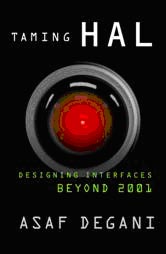
my new book, Taming HAL, I will
explain the kind of miscommunications that frequently occur between humans
and machines by delineating the differences between models of machine behavior
and models of (user) tasks and processes. I will present several examples,
from consumer electronic and medical devices to ship navigation and modern
autopilot design, in order to illustrate fundamental interface and interactions
problems that can plague systems. Using examples from 2001: A Space Odyssey,
I will show parallels between HAL's dangerous behavior and current automation
design.
|
Asaf Degani is a research scientist at Code IC (NASA Ames Research Center).
Working at Ames since 1989, he has conducted observational and simulation
experiments on human factors aspects of cockpit design, procedure usage and
development, and automated decision aids. His current research work is on
development of interface design methodologies for controlling automated systems
(e.g., the next generation Mars rovers), and mathematical approaches for analysis
and design for emergency/abnormal procedures (used by pilots of commercial
aircraft). He holds a maritime master ticket, a private pilot license, and
a Ph.D. in Industrial and Systems Engineering from Georgia Tech. |
|