Marc Davis
UC Berkeley School of Information Management and Systems
Mobile Media Metadata: The Future of Mobile Imaging
April 2, 2004
The devices and usage context of consumer digital photography are undergoing
rapid transformation from the traditional camera-to-desktop-to-network image
pipeline to an integrated mobile imaging experience. In 2003, more camera
phones were sold than digital cameras worldwide. The ascendancy of mobile
media capture devices makes possible a significant new paradigm for digital
imaging because, unlike traditional digital cameras, camera phones integrate
capture, programmable processing, networking, and rich user interaction capabilities
in one mobile device. We will discuss our Mobile Media Metadata prototype
(MMM) which leverages the spatio-temporal context and social community of
media capture to infer media content. In our approach we:
· Gather all automatically available information at the point of capture
(time, spatial location, phone user, etc.)
· Use metadata similarity algorithms to find similar media that has
been annotated before
· Take advantage of this previously annotated media to make educated
guesses about the content of the newly captured media
· Interact in a simple and intuitive way with the phone user to confirm
and augment system-supplied metadata for captured media
As a result of this approach, we believe we will solve a fundamental problem
in personal media production and reuse-the need to have content-based access
to the media consumers capture and share on mobile imaging devices. This talk
will address our Mobile Media Metadata technology, various mobile media applications
designs, user interaction issues, and future project in mobile imaging.
|
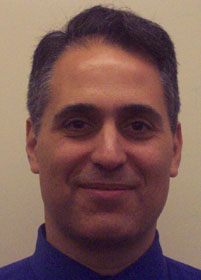
Marc Davis
is an Assistant Professor at the School
of Information Management and Systems (SIMS) at the University of California
at Berkeley where he directs the Garage
Cinema Research group (http://garage.sims.berkeley.edu). His work is focused
on creating the technology and applications that will enable daily media consumers
to become daily media producers. Prof. Davis’ research and teaching encompass
the theory, design, and development of digital media systems for creating
and using media metadata to automate media production and reuse. As part of
his doctoral dissertation at the MIT Media Laboratory, he developed Media
Streams, an iconic visual language for annotating, retrieving, and repurposing
digital video. From 1993 to 1998 at Interval Research Corporation, he led
research and development teams in automatic media production technology for
which a patent was awarded in 2001. From 1999 to 2002, Prof. Davis was Chairman
and Chief Technology Officer of Amova, Inc., a developer of media automation
and personalization technology. At UC Berkeley, Prof. Davis is a Co-Founder
and Executive Committee Member of the interdisciplinary Center for New Media
(CNM). He is also an Advisory Board Member of the Art, Technology, and Culture
Colloquium (ATC) and an Affiliated Faculty Member of the Berkeley
Institute of Design (BiD). |
|