Ka-ping Yee
UC Berkeley
Peephole Displays: Pen Interaction on Spatially Aware Handheld Computers
May 16, 2003
Peephole Displays are pen-operated handheld computers that
track their own position in order to provide a movable window
on a virtual workspace. Previous research has explored various
ways of using spatially tracked displays, in particular as windows
onto 3-D virtual realities. This work is a bit different in that
it looks at combining pen input with spatial tracking, and borrows
manipulation techniques from familiar 2-D displays.
With a Peephole Display, you can use both hands together:
the hand holding the display can navigate through information,
and the hand holding the pen can manipulate that information.
Thus, you can navigate and manipulate simultaneously, without
interrupting the flow of work. It's also possible to manipulate
objects larger than the screen more easily using Peephole techniques.
Peephole displays also enable a few totally new kinds of interaction,
such as 3-D drag-and-drop.
In this talk, I'll describe and illustrate the Peephole concept,
and show a video demonstration of some applications that take
advantage of Peephole interaction techniques. I'll also describe
the results of a user study to assess the feasibility of these
techniques for PDAs, and show some more speculative ideas on
future possibilities.
|
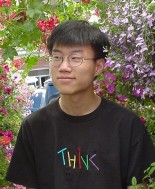
Ka-Ping Yee is a Ph. D. student
in Computer Science at UC Berkeley specializing in HCI. He has
previously worked at Alias|Wavefront, Xerox PARC, Industrial
Light and Magic, and Opera Software, and has participated in
the development of the Python programming language. His research
interests include critical discussion, information visualization,
capability-based security, and secure interaction design. |
|