Sidney Fels
University of British Columbia
Building Novel Interfaces
December 8, 2000
For an interface to be successful it should address the physical,
emotional and cognitive aspects of the user. In effect, the interface
should feel "good" to use. People and objects form
relationships based upon the interface available. There are four
types of relationships which can form between people and objects.
The relationships that form depend upon whether a person embodies
an object, i.e., feels the object is an extension of himself
or whether the object embodies the person, i.e., the person submits
to the manipulations of the object. In the former situation,
the process of embodiment can be seen as the formation of intimacy
between a person and the device. In the latter case, the process
of embodiment often has to do with the desire for belonging or
the dissociation of oneself from an object that you are controlling.
Each of these relationships have their own aesthetic appeal.
In this talk, I will introduce some of the work I have been
doing with building novel human-machine interfaces that explore
some of the issues of intimacy and embodiment of the interface.
Some of the projects I plan to discuss are: Glove-TalkII, the
Iamascope, Video Cubism, Sound Sculpting, and the Forklift Ballet.
If we have time, I'll show video of some other interesting interfaces.
Glove-TalkII is an adaptive gesture-to-speech device which works
like a musical instrument for speech. The Iamascope is an interactive
artwork that places the participant into a large video-based,
musical kaleidoscope. Video cubism is an interactive volumetric
visualisation of video data. Sound sculpting is a sound design
interface that uses virtual physical objects to manipulate the
quality of sound. The Forklift Ballet is a dance piece using
forklifts to demonstrate the relationship between skill, aesthetics
and expression. Each of these projects has implications for developing
a theory on human-machine interaction.
|
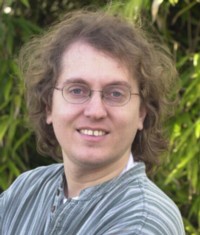
Sidney Fels received
his Ph. D. and M.Sc. in Computer Science at the University of
Toronto in 1994 and 1990 respectively. He received his B.A.Sc.
in Electrical Engineering at the University of Waterloo in 1988.
He was a visiting researcher at ATR Media Integration & Communications
Research Laboratories in Kyoto, Japan from 1996 to 1997. He also
worked at Virtual Technologies Inc. in Palo Alto, CA developing
the GesturePlus™ system and the CyberServer™ in 1995.
His research interests are in human-computer interaction, neural
networks, intelligent agents and interactive arts. Some of his
research projects include Glove-TalkII, Glove-Talk, Iamascope,
InvenTcl, Sound Sculpting and the context-aware mobile assistant
project (CMAP). |
|