Terry Winograd||François Guimbretière||Brad Johanson
Stanford Computer Science||Stanford Computer Science||Stanford Computer Science
Experiments in Interaction with Wall Displays
November 17, 2000
As display technologies continue to mature, we are approaching
the day when large wall-mounted displays will be a common part
of business, educational, and home environments. Today most uses
of wall-displays are indirect. An audience views the large screen,
while a presenter interacts with a workstation, laptop, or small
device to control what appears. Early explorers of ubiquitous
computing developed interactive wall displays, such as the Xerox
Liveboard, They learned that to provide good interaction
with these displays it was necessary to go beyond a simple translation
of the standard keyboard/pointer interaction with workstations,
and the physical mark-based interaction of non-computerized whiteboards
or chalkboards.
In our Interactive Workspace, we are exploring new methods
for multi-person interaction using multiple large wall-based
displays. This talk describes some preliminary experiences as
we begin to develop the interaction architecture. We will describe
and show video clips of four of these explorations:
FlowMenu: Combining command, text, and parameter entry with
an integrated context menu.
Geometer's Workbench: An active blackboard for geometrical
exploration (with Sha Xinwei)
BareHands: Implement-free interaction with a wall-mounted
display (with Merrie Ringel)
PointRight: A system for pointer/keyboard redirection among
multiple displays and machines (with Brad Johanson, Greg Hutchins)
|
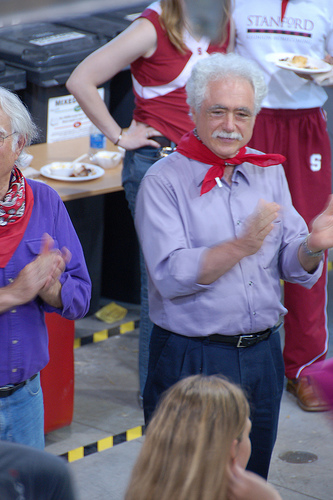
Terry Winograd
is Professor of computer science at Stanford University, where
he directs the program in
Human-Computer Interaction. His current research interests
include participation in the Digital
Library Project and the Interactive
Workspace Project. He has written or edited several books
related to human-computer interaction, including Understanding
Computers and Cognition (with Fernando Flores), Usability:
Turning Technologies into Tools (with Paul Adler) and Bringing Design to Software.
François
Guimbretière is a PhD student in Computer Science
at Stanford, who has been a primary developer of the Interactive
Mural, including the physical, computational, and interactional
aspects. |
|