Jitendra Malik
Computer Science Division, UC Berkeley
Finding Objects in Large Collections of Images
October 3, 1997
Retrieving images from very large collections using image
content as a key is becoming an important problem. The UC Berkeley
digital library group has adopted a particular perspective on
the problem--namely, that users are primarily interested in scenes
containing particular objects or configurations of objects. To
make this possible, we believe the key aspects are (a) grouping
image data into regions corresponding to objects, or parts of
objects (b) recognizing particular configurations of regions
as objects based on color, texture, shape or spatial arrangment
(c) use learning techniques to assist in the acquisition of common
chractersitics of visual categories.
We have defined a blob world representation which provides
a transition from raw pixel data to a small set of localized
coherent regions in color and texture space. Users can construct
queries using the blob-world represntation; automatic machine
learning techniques can use it to acquire visual categories such
as tigers, eagles and airplanes based on a set of examples. We
have also demonstrated the use of spatial arrangements of regions
(a ``body plan'') to learn and recognize instances of humans
and horses from a very large collection of images.
|
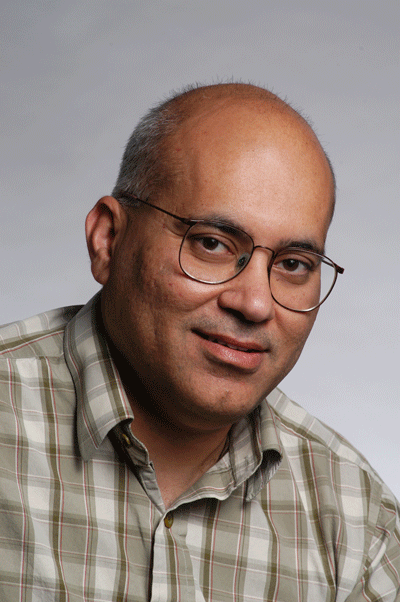
Jitendra Malik was born in Mathura, India in 1960. He received
the B.Tech degree in Electrical Engineering from Indian Institute
of Technology, Kanpur in 1980 and the PhD degree in Computer
Science from Stanford University in 1986. In January 1986, he
joined the faculty of the Computer Science Division, Department
of EECS, University of California at Berkeley, where he is currently
Professor and Vice-Chair of Graduate Matters. He is a member
of the Cognitive Science and Vision Science groups at UC Berkeley.
His research interests are in computer vision and computational
modeling of human vision. His previous work has spanned a range
of topics in early and intermediate vision including image segmentation,
texture, stereopsis, motion analysis, and line drawing interpretation.
Currently, he is also interested in the application of computer
vision to intelligent vehicle highway systems. He received the
gold medal for the best graduating student in Electrical Engineering
from IIT Kanpur in 1980, a Presidential Young Investigator Award
in 1989, and the Rosenbaum fellowship for the Computer Vision
Programme at the Newton Institute of Mathematical Sciences, University
of Cambridge in 1993. |
|