Donald Norman
Hewlett-Packard Laboratories
Toward the third generation of the PC: Lessons learned from Thomas Edison
May 30, 1997
Thomas Edison was a great inventor, but a crappy businessman.
Consider the phonograph. Edison was first (he invented it), he
had the best technology, and he did a brilliant, logical analysis
of the business. As a result, he built a technology-centered
phonograph that failed to take into account his customer's needs.
In the end, his several companies proved irrelevant and bankrupt.
Sound familiar? That's today's PC business. There are even
more parallels. Speak of ease of use: It was judged to be too
complicated for office use. The early phonograph took about two
weeks to master, if you were willing to persevere. Today's computers
take even longer. In general, whether it is the phonograph or
the computer, the technology is the easy part. The difficult
parts are social, organizational and cultural.
Note that the phonograph went through a number of major revolutions
in its lifetime. Cylinders. Disks. Acoustical, electrical. When
the radio came out, it almost killed the phonograph business.
78 RPM to 33 1/3 and 45 RPM. Cassette tapes. CDs, mini-discs.
DVD, And so on. If you compare the computer industry to the phonograph
one, we are still producing 78 RPM shellac discs.
This talk addresses the changes we might expect to see in
the information technology world. And the process by which they
might come about.
|
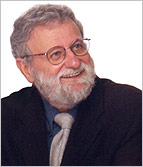
Don Norman is former Vice President of Research, Apple Computer
and Prof. Emeritus of Cognitive science, University of California,
San Diego. He is the author of lots of stuff, including "The
psychology of everyday things" and "Things that make
us smart." Right now he is in the process of accepting a
job at a major computer company to lead the initiative to the
3rd generation of the PC. And, of course, to write another book. |
|