Alex Waibel
Interactive Systems Laboratories, Carnegie Mellon University and University of Karlsruhe
Speaking with your Voice, Pen, Eyes, Face, Hands, and Fingers
April 4, 1997
Human-Computer Interaction to date is severely impoverished
by the sensory deprivation of a machine that can only interact
with its environment by way of the keyboard and mouse. By contrast,
human-to-human interaction involves speech, writing, eye-contact,
lip-reading, hand-gestures, pointing, and a host of sophisticated
interactive mechanisms to transmit information from one person
to another robustly and flexibly, and the ability to learn from
this interaction.
In this talk I will describe work we are doing at our lab
to enable computer agents to deliver similar agility, flexiblity
and naturalness to human-computer interaction. I will describe
the scientific challenges behind recognizing conversational speech,
cursive handwriting, gesture, pointing and lip-motion, tracking
faces, eyes, head-orientation and sound sources and the solutions
we have developed to date to track and interprete these signals
robustly. An important opportunity arising from the *combination*
of these modalities is the increased robustness of the overall
interface that results from interpreting human intent from the
*joint* and complementary cues provided by a human. More interestingly,
remaining errors can be repaired quite effectively and naturally
by switching between communication modes (speaking, spelling,
writing, etc.) that provide another look at the same words or
concepts.
I will then describe (and show videos of) several user interfaces
that embody these multimodal capabilities. QUICK_DOC and QUICK_TURN
are example systems that are developed to allow medical doctors
or image analysts to access, manipulate, multimedia records and
rapidly create and disseminate reports based on this information.
The (multimedia) information is manipulated, searched and delivered
by voice, pointing and handwriting and Web-reports automatically
generated to achieve faster turn-around. The systems are implemented
as a Web based client/server architecture, where voice, pen and
other signals can be captured at a (potentially mobile) client
side, and processed, interpreted and serviced elsewhere.
|
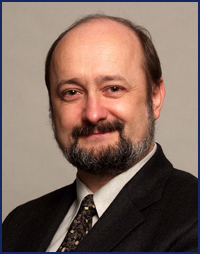
Alex Waibel is a senior research scientist in the School of
Computer Science at Carnegie-Mellon University. His research
interests center on the interpretation and integration of speech,
language, and other human communication signals for better human-computer
and computer-mediated interaction. Two particularly challenging
examples of those interests are the JANUS
project, a speech-to-speech translation system that translates
spoken language between English, German, Japanese, and Spanish
(e.g., a translating telephone), and the INTERACT
project, which attempts to design multimodal interfaces. |
|