Terry Winograd
Stanford Computer Science
Interacting with the Digital Library
November 3, 1995
As information of widely diverse types and origins becomes
a part of the world's digital library, a key problem is the integration
of heterogeneous materials into a common platform. This includes
work on widely-applicable formats, protocols, and representations,
which can support services for access, search, information transformation,
display, archiving, and the like. It also requires new tools
for the user, which can bring a uniform conceptual model to the
full range of information tasks, for providing, organizing, manipulating
and viewing information.
This talk describes work in progress in the digital
libraries project at Stanford, in the area of interface and
interaction. I will describe the general context of the research
and present some examples of specific projects and the issues
that they are addressing.
|
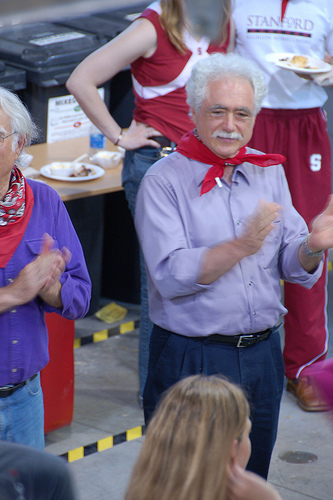
Terry Winograd is Professor of Computer Science at Stanford.
He began his career in computing in the field of Artificial Intelligence,
specializing in natural language understanding. After rethinking
the problems and potentials of computational intelligence (see
Winograd and Flores, Understanding Computers and Cognition,
Addison-Wesley, 1987), he left AI research and for the last decade
has worked in the area of human-computer interaction. He initiated
the Project on People,
Computers and Design and the program in Human-Computer
Interaction at Stanford. His previous books include Usability:
Turning Technologies Into Tools (edited with Paul Adler,
Oxford, 1992) and he is the editor of a forthcoming book, Bringing
Design to Software, Addison-Wesley, 1996.
Winograd was a founder and past-president of Computer
Professionals for Social Responsibility and is on the USACM
public policy committee, and the advisory Board of the Association
for Software Design , the Universal Access Project of the
World Institute on Disability. He was a founder of Action Technologies,
and consults at Interval Research, which is one of the sponsors
of the work being presented in this talk. |
|