Donald Norman
Apple Computer
An academic discovers the realities of design
December 2, 1994
We are indeed in the midst of a most interesting technological
revolution, one which joins communication, computation, and entertainment.
Things are moving rapidly, and in another century, the way we
live our lives will have been transformed rather dramatically,
perhaps equivalent to the past one hundred years in which my
parents, for example, started in a world where horses were the
main transportation, the telephone was not in widespread use,
and people rarely traveled more than a few miles from their homes
during their entire lives.
Today, in HCI courses around the world, we worry about the
details of today's technology. We have lofty theories, lofty
ideas. But what is the relationship between the ideals of the
world of academics and of design and the world of industry? Hmm.
Why do you think there should be any relationship?
The world of industry is driven by the business model: what
sells. Indeed, my current standard talk to conferences is entitled:
"Trends in the Computer Industry: Life-Long Subscriptions,
Magical Cures, and the Search for Profits Along the Information
Highway"
So in this talk, let me tread a dangerous walk along the boundary
between hope and despair. One the one hand, I will argue that
artifacts of technology can indeed make us smart, that we are
in the midst of most interesting times. On the other hand, I
will also argue that those in power are primarily driven by their
perception of the marketplace, that if we are not careful, hollywood
standards will dominate the information industry -- low standards
in culture, low standards in content, high standards in glitter,
and a price for everything.
Is there a positive side to this? yes. But it will require
consierable change, including reorganizing how companies develop
product. The theory of HCI is the easy part: restructuring the
industry so that our dreams can actually occur is the hard part.
|
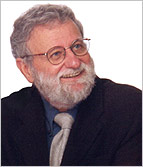
Donald A. Norman is an Apple Fellow at Apple Computer and
Professor Emeritus at the University of California, San Diego
where he was founding chair of the department of Cognitive Science.
He was one of the founders of the Cognitive Science Society and
has been chair of the society and editor of its journal, Cognitive
Science. He is a fellow of the American Academy of Arts and Sciences.
"The technological problems today," says Norman,
"are sociological and organizational as much as technical.
In this new age of portable, powerful, fully-communicating tools,
it is ever more important to develop a humane technology, one
that takes into account the needs and capabilities of people."
Norman is the author of the book "The Design of Everyday
Things." His most recent books are "Turn Signals Are
the Facial Expressions of Automobiles" and "Things
That Make Us Smart." All three books are now available on
a Voyager CD-ROM - Defending human attributes in the age of the
machine - complete with video talks, demonstrations, collected
papers, and even examinations. |
|