Brenda Laurel
Telepresence Research Inc.
Be There Here: Telepresence and Virtual Reality
November 6, 1991
Telepresence is a term used to describe an emerging medium
that enables a person to feel as if he or she is physically present
in a different place or time. 'Virtual reality' and 'artificial
reality' are popular names for this field. Today, telepresence
technology typically involves head-coupled stereoscopic displays,
three-dimensional audio environments, and body- or hand-coupled
input devices. Telepresence technology can provide the experience
of being in two different kinds of spaces: computer-generated
environments, and actual environments that are distant in space
and/or time. The telepresence medium has inherited the rather
contradictory traits of an obsession with photorealism from computer
graphics and a penchant for metaphor from the realm of human-computer
interface design. Its unique characteristics have also made telepresence
and "virtual reality" the target of both fanciful and
profound commentary from philosophers, feminists, ethnographers,
and artists. Telepresence is thus an excellent context for discussing
the evolving relationship between people and computer technology.
This talk will begin with a definition of the idea of presence,
a primer on enabling technologies and applications, and then
will focus on critical research and design issues in telepresence.
|
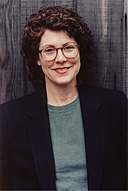
Brenda Laurel has worked in the personal computer industry
since 1976 as a programmer, software designer, marketeer, producer,
and researcher. Her academic background is in theatre, and she
holds an M.F.A. and a Ph.D. in theatre from Ohio State University.
Her work on computer-based interactive fantasy architectures
was begun at the Atari Research Lab in 1982 and was published
in her doctoral disseration in 1986. From 1987 to 1990 she worked
as a consultant in interactive entertainment and human-computer
interface design for such clients as Apple Computer, LucasArts
Entertainment, and the School of Computer Science at Carnegie
Mellon University. In 1990, she joined Scott Fisher in founding
Telepresence Research, a company to conduct research and development
in virtual environments and remote presence technology and applications.
Brenda has published extensively on such subjects as "virtual
reality" design, computer-based agents, and interactive
fiction. She is editor of the book, THE ART OF HUMAN-COMPUTER
INTERFACE DESIGN [Addison-Wesley, 1990] and author of COMPUTERS
AS THEATRE [Addison-Wesley, 1991]. |
|