Ted Nelson
Autodesk Inc.
The Six Nelson Paradigms for Interactive Software or Pac-Man, the Prototype For Office Systems
March 6, 1991
THE SCHOOLS OF THOUGHT: AI/Media Lab, PARC, Nelson (mostly
unheard). HOW WRONG IT'S GONE! Fascist PC versus MacBotch; the
crime of Wizzywig, the folly of "metaphors," the delusion
of "functionality," the evil of "files,"
the horror of "applications" (fanning out fractally).
MY SIX ORTHOGONAL PARADIGMS, variously intercombining: CINEMA:
Interactive software is a movie and more: screen presentation
to mind and heart of viewe, plus interaction. Global optimization,
a definition of Art: all parts unite and co-impact, the task
cannot be decomposed into delegable parts, must be centralized
in the mind and heart of the Director. A wide variety of effects
are on the palette, with various costs as production values (or,
in software, performance values). VIRTUALITY, the seeming of
something: its conceptual structure and feel. VIRTUALITY VS.
METAPHOR: unified, designed generality versus complexity built
up from scraps. GOOD SOFTWARE DESIGN IS DESIGN OF ABSTRACT CONCEPTUAL
SPACES, which must be designed as wholes under a unifying artistic
commander, as in film. Unified conceptual structure is vital;
thus the structangular design of abstract virtuality is the fundamental
process of software design. The feel (in film, atmosphere and
mise-en-scene) must be designed and perfected by the Director's
many different adjustments throughout. THEMATICS, a new threaded
metalogic of structure, definition and inner meaning, defined
in terms of principles, instances and ramifications. (Part of
Nelson's General Schematics.) Unity and organization may be defined
as thematic metapredicates. Thematic evolution of Pac-Man; how
its brilliant achievements foreshadow true office software. The
search for cross-cutting organizational threads Clever collapsing
of function and controls (as in JOT(tm) text editor and PAC-MAN)
versus disastrous collapsing (Mac garbage can). FANTICS, the
art and science of presentation (subsuming cinema, writing, diagrammatics
and much more). VISUALIZATION or mentalization: anything can
be visualized, using enough tricks. Many views and flipping them
fast. Multidimensionality; paradoxical and punned spaces. The
Word-Picture continuum, the Word-Picture-Interaction Continuum.
Mapping of Contents/Subject Field to Presentational Space to
Controls. SEEING CONNECTIONS (Our windowing conventions, such
as Xwindows, are screwed up, since they do not allow lines to
be drawn from contents of one window into the contents of another.
These conventions will have to be replaced.) CONVENTIONS IN ALL
MEDIA: physical, visual, acoustic units, overlays, contexts,
markers, transitions, groupings, identifiers, paragraphs, layouts,
montages, jingles. SOCIAL CONTEXT OF USAGE, eg classroom, TV
viewing, radio at work. ORGANIZATIONAL CONTEXTS, esp. time-slot
and season schedule. LITERATURE: the Final Conglomeration. The
document and "literature" defined and generalized into
the screen and repository future. TOWARD A UNIFIED LANDSCAPE
OF DATA. The Xanadu(tm) model of true representation, interconnection,
versioning, repository publishing, and copyright simplification.
ACCESS STRUCTURE MAPPING, discrete and weighted. Maps of what
you can get to from where are crucial to all designs (including
architecture, clothing, office systems and interactive software).
Till now we have not explicitly designed such structures, resulting
in such interconnective horrors as Lotus menus and the New York
subway system.
|
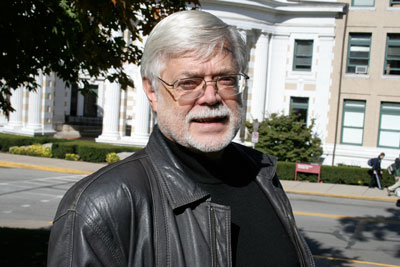
Generalist, futurist, visionary, designer, showman, computer
folk hero, rogue intellectual, magician of the mind and living
legend Ted Nelson is best known for his book _Computer_Lib_ and
for coining the words "hypertext" and "hypermedia"
in the early sixties. He is the founding designer of the Xanadu
project, soon to result in a product from Autodesk, and intended
to become the world publishing repository of the future. He presently
holds the titles of Distinguished Fellow at Autodesk, Inc., and
Visiting Professor at the University of Strathclyde, Glasgow,
Scotland. He has degrees in philosophy and sociology from Swarthmore
and Harvard. His next books will be entitled _Biostrategy_and_Polymind:_A_New_Theory_
of_Human_Life_ and _The_Human_Sexual_System_. He has been a film-maker,
dolphin researcher and folk singer. He is active in the program
of the Human Awareness Institute, a California love cult. |
|