Terry Winograd
Computer Science Department, Stanford University
A Human-Centered Architecture for an Interactive Workspace
October 2, 1998
Human Computer Interaction is increasingly engaged with the social-cultural context that people live in everyday. The city, in all its grit and glory, provides a complex and rich context in which to understand the challenges technologies face when they are adopted by people in the real world. In this presentation, I discuss three on-going research initiatives from my group at Cornell Tech in New York City which grapple with interaction in the urban context: Trashbots in the City, Urban Fingerprinting, and Communal eXtended Reality. These projects highlight different aspects of urban interaction--culture, scale, engagement--which demand new approaches from researchers and practitioners in HCI. In this talk, I will also champion the perspectives that HCI brings to the already crowded urban landscape.
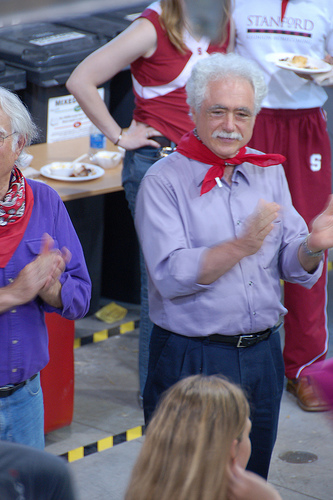
Terry Winograd is Professor of Computer Science at Stanford
University where he directs the teaching and research programs
on Human-Computer Interaction Design. His early research
on natural language understanding by computers led to two books
and numerous articles on that topic. His book, Understanding
Computers and Cognition: A New Foundation for Design (Addison-Wesley,
1987, co-authored with Fernando Flores), took a critical look
at work in artificial intelligence and suggested new directions
for the design of computer systems and their integration into
human activity. He co-edited a volume on usability with
Paul Adler, (Usability: Turning Technologies into Tools,
Oxford, 1992). His most recent book, Bringing
Design to Software (Addison-Wesley, 1996) brings together
the perspectives of a number of leading proponents of software
design.
Winograd is one of the principal investigators in the Stanford Digital Libraries
Initative project, a collaboration with industrial partners to
develop technologies for the future networked Digital Library. He
was a founder of Action
Technologies, a developer of workflow software, and was a
founding member of Computer Professionals
for Social Responsibility, of which he is a past national
president. He is also a consultant to Interval
Research Corporation, on the national advisory board of the
Association for Software Design, and on the editorial board of
several journals, including Human-Computer Interaction and Computer-Supported
Cooperative Work. |
| |