Project 2: Change is Hard
Paper to Pixel. Goal: Learn how to work with Flows, Wires and a Conscience.
Overview
- In week 3, you will form a team, pick a behavior design goal, and launch a diary study.
- In week 4, you will synthesize the results of the study into a journey map and plan out the flow of a design informed by the results.
- In week 5, you will refine this flow into a prototype that you can test
- In week 6, you will perform a field study of the prototype.
Part 1: Research the Opportunity Space
We will do a deeper dive into integrating research into design in P2.
First, form team of 3 people in your studio. The rules are simple: you can pick your own teams, but later, for P3, you will only be able to work with one member of your original P2 team. So think about what team you want for this project and the next.
Our focus in P2 is behavior change. To make this more interesting, we will focus only on behavior changes that people can do over a four-day behavior change sprint. Your design goal should be fully achievable during the four days, e.g.,
- Go to bed on time for four days in a row
- Read for fun each day
- Meet a new person each day
- Eliminate sugar and track energy levels
Rather than treating the four days as the start of a longer effort (e.g., lose weight, establish a routine of going to the gym), the object of this effort is learning what one is capable of and/or habit building.
Come with a team and a behavior change goal to Studio 3B.
As a team:
- Recruit eight people who are interested in the goal. Diary studies are notorious for having people drop out, and you want there to be at least five people who complete it.
- Perform a four-day diary study with each participant, capturing their thinking and behavior around the goal of interest. Think critically about what you will be asking them to keep track of in the diary — what is the most effective study protocol given your goals? You may want to have participants send you their entries at the end of each day so that you can read and process them incrementally.
- Capture the results in Google Docs, and familiarize yourself with them before studio.
- Bring the diaries with you to Studio 4A.
In Studio 4A, we will start working on synthesizing the diaries. The next steps are now:
- Conduct at least three follow-up interviews with diary study participants. Each team member should lead an interview, ideally accompanied by another teammate. Capture the interview by having one team member take notes or by recording the interaction and using rev.com. Make sure you read through any interviews you did not attend.
- Create journey maps individually (one per team member). Journey map video
- Bring the interview transcripts and journey maps with you to Studio 4B.
Part 2: Model the System
The goal is now to design a system that helps people achieve the behavior change goal. Don't start with screens — that's not what's important yet. How do you intercede with the user's motivation, ability, and trigger?
Your design may not be an app, and it may not even require a screen. Consider SMS (Twilio), Slack, or other surfaces that might nudge people.
First, create a mindmap of potential elements.
Second, create a system map (use case map) to identify who the actors are, and how people will move through the system. See this article for more info: "Tools for Systems Thinkers: Systems Mapping"
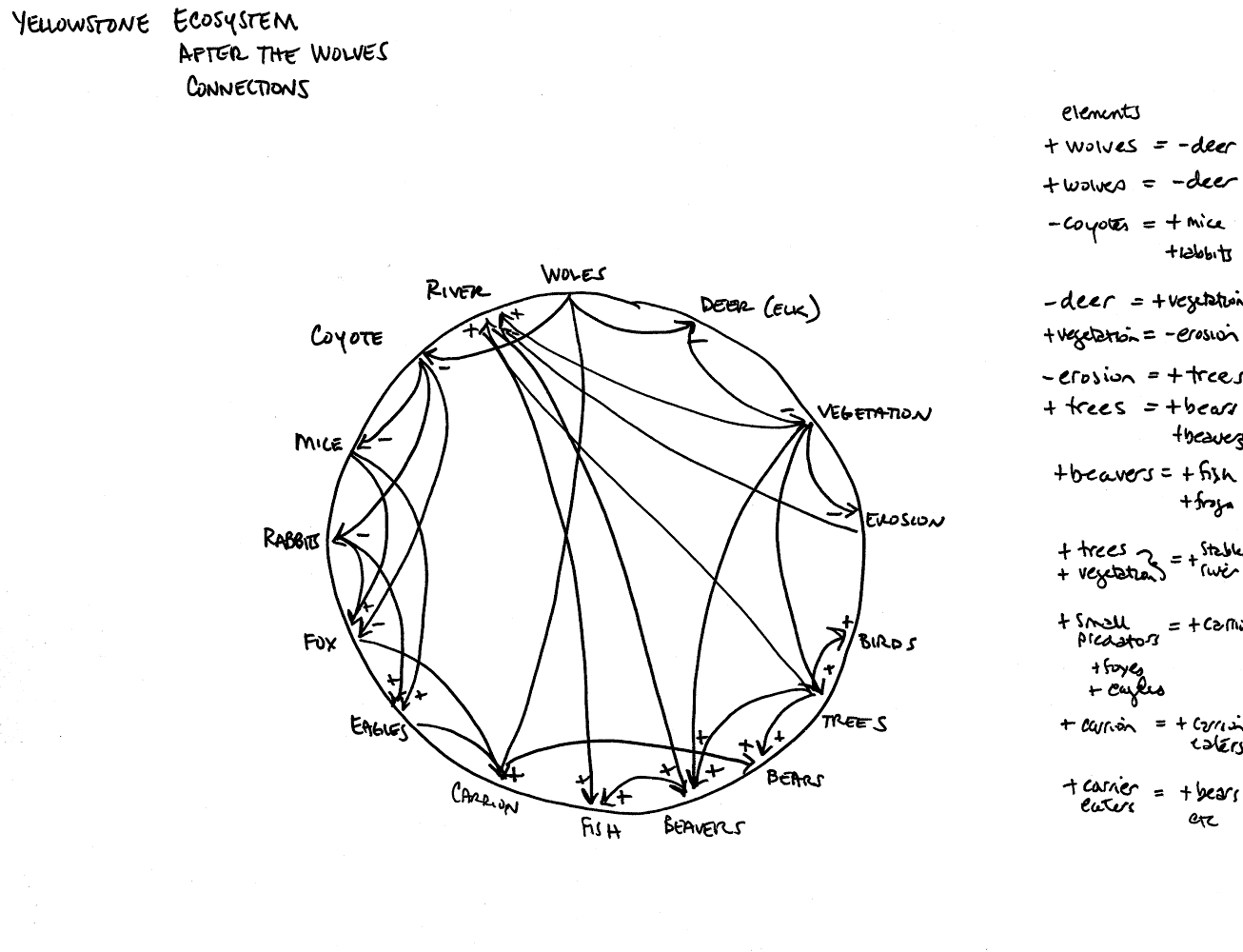
Finally, create a flow for the design and how it influences user behavior.
- Create a storyboard for the main use case. It should describes the user, their challenge, and how the design influences their behavior.
- Identify decision points you will offer. WHERE/HOW WILL YOU DO HABIT BUILDING? How do you keep people from opting out of habit support?
- Storyboard any critical branching choices or alternative outcomes. Include details about prompts/messaging.
Bring all of the above artifacts with you to studio 5A. One set per team.
Part 3: Specify the Interaction
Next we’ll expand the storyboard to a more concrete interface. To do so, first clarify for yourself: what question are you trying to answer with your prototype? Rather than creating a prototype of uniform depth across the entire system, articulate what is the biggest, riskiest, unanswered question about your design concept, and focus the prototype and interface on answering just that question.
Armed with your question, create a wireflow of your design to answer it. A wireflow is an advanced technique that combines simple wireframes with flowcharts. See pages 38–40 of this description. Do NOT use Lorem Ipsum. Use your intended language.
This requires thinking through dialogue design and parsing (if an SMS interface, for example.) What kind of conversational tone does the system have — a nanny, a friend, a cop? How do you ensure that the user's response is structured so that you can parse it out? Will it be important to capture whether they actually did the desired behavior?
Bring your prototype's question, and the wireflow that can help you answer the question, with you to studio 5B. One set per team.
Part 4: Field Study
Following feedback in studio 5B, your goal is to complete a rapid prototype that addresses your design's biggest unanswered question. Start by reflecting on the biggest unanswered question that you previously articulated, and make sure that you can describe what kind of prototype you need to build to answer it.
We expect that for many projects, the prototypes will involve some small amount of coding. Remember that you don't have time to build a full app, so focus on how to hack a prototype that gets you feedback on the core question. For example, instead of an iOS app, you might do an SMS-based interface that uses the Twilio API and cron to ping users. Or, if your users keep Slack notifications on, you might build a minimal Slack bot that uses DMs and their buttons API.
You'll want to co-design your prototype with the field study plan. We don't expect a randomized study with multiple conditions here. However, before you start, think through what method will allow you to answer your prototype's question most directly. This requires thinking through:
- What kind of training will users receive?
- What data will you record?
- What will you measure?
- What interview questions will you ask participants at the conclusion of the study?
- What would you consider to be success? What is the most likely reason that the design might not achieve its goals?
- What will you discuss with the participants? Do the deployment. Interview participants. Synthesize. Write a report.
Bring a first-draft prototype ready for peer usability testing, and your experimental worksheet for the field study method, to studio 6A. Your prototype may still have some wizard-of-oz'ed components rather than code.
Iterate based on the peer feedback in studio, complete your prototype and revise your study method. Bring synthesis of prototype validation to class to studio 6B. You will have 5 min to present per team and we will critique.
Now it's time to begin your field study. You'll want to aim for five participants finishing the study, so recruit seven or eight to start. Ideally, these participants should engage with your design over four consecutive days toward the behavior change goal. At the conclusion of your field study, interview your users for more detail.
Document your observations, and synthesize them into high level findings. Support the findings with specific evidence and examples (e.g., quantitative data, quotes from interviews, behavior logs from the application). Specifically, include the following sections:
- Method: Describe who you recruited and how you recruited them; what process you had them follow; what you recorded, measured, and asked them in the follow-up interviews.
- Results: A high level description of what happened. For example: How did people engage with your design? What behaviors changed? Did they persist? What unanticipated secondary effects arose? Don't interpret the results or explain why they happened — focus on what happened.
- Discussion: A synthesis and interpretation of why the results came out the way they did.
- Reflection: What did you learn about your design? How might you change it, or pivot your design, if you were to continue?
Present your final report in studio 7B. This presentation will not be graded, but will be the best way to communicate your final deliverables in studio. Your 5-min presentation should have the following general outline.
- What problem are you solving?
- What did you learn through your diary study?
- What design did you end up prototyping?
- What were the results of your field study?
- What did you learn from those results?
Submit
A PDF with ALL your work and ideas documented with captions explaining your process.
Documentation contents:
- Research: Your documentation of the diary study, including your diary study plan and any materials you gave to participants, follow-up interviews and journey map.
- Flow and Interaction: Your description of the design you ended up choosing, and why. Include the mindmap, system map, design flow storyboards, and wireflow that led to it.
- Field Study: Your description of the field study and your synthesized findings: experiment worksheet documenting the method, any artifacts that communicate the prototype that you created, results of the study, discussion, reflection.
Submit on Canvas.
Grading rubric
This rubric will apply to the final submission. We put it here from the start so that you can see how the intermediate parts play into the final evaluation.
| Category | Scores | |||
|---|---|---|---|---|
Research 7pts |
[1 / 7pts]
Diary study does not correctly follow the method or is nonexistent
|
[3 / 7pts]
Diary study is incomplete or does not derive insights
|
[5 / 7pts]
Diary study is complete but focuses on surface-level insights about the habit
|
[7 / 7pts]
Diary study uncovers nontrivial insights about the habit
|
Flow and Interaction 7pts |
[1 / 7pts]
Design is incomplete or does not intervene on the habit
|
[3 / 7pts]
Design is not well targeted to change the habit
|
[5 / 7pts]
Design is moderately targeted to change the habit, but may not make realistic assumptions, or is too heavy-handed or light touch in its approach
|
[7 / 7pts]
Design represents a creative, effective intervention on the habit
|
Field Study 7pts |
[1 / 7pts]
Field study does not correctly follow the method or is nonexistent
|
[3 / 7pts]
Field study is incomplete or does not derive insights
|
[5 / 7pts]
Field study is complete but focuses on surface-level insights about the design and the habit
|
[7 / 7pts]
Field study uncovers nontrivial insights about the design and the habit
|
If any of the deliverables are missing, we will reduce your score by 25% per deliverable.