
In this assignment, you and your teammates will create visual storyboards of how people accomplish a goal. To accomplish this assignment, your group will need to agree on a goal that your project will help people achieve. In selecting a goal, we encourage you to build on what you and your peers learned through the "Inspiration" and "Discovery" assignments. Note: deciding on a goal is not the same as deciding on a particular interface. In fact, creating storyboards that enumerate alternative ways to accomplish this goal is what this week's assignment is all about: breadth is an explicit goal.
You have already formed small project teams of three people, informed by the work areas: Design, Development, and Evaluation. This will be your project team for the rest of the quarter. This week, each individual in the group must submit a storyboard for this assignment and it will be assessed individually. You are encouraged to discuss with your team about what ideas to storyboard so as to maximize productivity and explore multiple concepts concurrently.
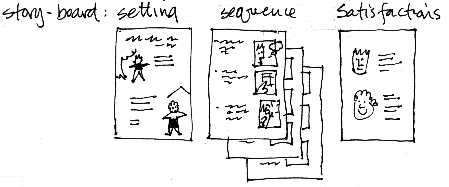 A storyboard is a comic-strip-like set of drawings about what your interface does and how it is used to accomplish tasks in an actual usage scenario. Draw inspiration from McCloud’s “Understanding Comics” reading as well as from the lectures this week. Your storyboards should be titled “How might we …?”, where you are to fill in a task to be accomplished. For example, your storyboard may be titled “How might we make finding an ice cream shop easier?”
or "How might we improve the experience of cooking for yourself?" For the
former, you could show a family on summer vacation who is looking for a cold treat. You could then illustrate how they would use your mobile ice cream locator interface to enter their desired flavor of ice cream and get directed to the nearest parlor. You should include sketches showing your interface’s actual presentation and layout, especially if there are tasks that will need to be completed by navigating menus, pressing a sequence of buttons, etc.
A storyboard is a comic-strip-like set of drawings about what your interface does and how it is used to accomplish tasks in an actual usage scenario. Draw inspiration from McCloud’s “Understanding Comics” reading as well as from the lectures this week. Your storyboards should be titled “How might we …?”, where you are to fill in a task to be accomplished. For example, your storyboard may be titled “How might we make finding an ice cream shop easier?”
or "How might we improve the experience of cooking for yourself?" For the
former, you could show a family on summer vacation who is looking for a cold treat. You could then illustrate how they would use your mobile ice cream locator interface to enter their desired flavor of ice cream and get directed to the nearest parlor. You should include sketches showing your interface’s actual presentation and layout, especially if there are tasks that will need to be completed by navigating menus, pressing a sequence of buttons, etc.
Be sure to check out Amal Dar Aziz's excellent Guide to Storyboarding.
Pick a primary task to be done with your interface - make it a task complex enough to fill up a storyboard. Create 3 alternative storyboards for accomplishing the same task, varying the interface itself, the scenario, or both. Each storyboard should require 5-8 panels, so in total you will have 15-24 panels to turn in. Each storyboard should fit on two 8.5” x 11” sheets of paper and be drawn with a thick pen like a Sharpie. Using a thick pen limits the amount of detail that you can add, forcing you to only draw the most important elements of scenario, user, and interface that communicate your ideas. Clarity, communicativeness, and innovation are more important than aesthetics here.
To complete this assignment, each group member must separately submit online:
Your summary will be submitted online as a body of plain text and digital photographs of your storyboard panels.
The submission website can be accessed through the course website with your SUNet login at https://hci.stanford.edu/cs147/studio/
To submit the assignment, log in to this website and click the Submit Assignment link in the Current Assignment box. On the submission page you can enter the writeup as well as upload any number of images. Clicking the "Save" button will save the current version of your writeup. Your latest save will automatically be submitted for grading when the assignment is due. You can save as many times as you need until the deadline.
Submit early! Late assignments will not be accepted!
This assignment will be evaluated on the four dimensions listed below.
After your studio, log into the studio web site, and assess the quality of your assignment. Do so by selecting the cell that best describes your assignment for each of the four dimensions.
The TAs will provide a nuanced grading of your submission performed blind of your own rating, To give you a better idea of what cell your assignment belongs to there are four student examples for you to look at with the TA grading shown.
More information about self-assessment
Grading Dimension |
Guiding questions |
Bare minimum |
Satisfactory
effort
& performance |
Above & Beyond |
| Task choice (max 5 points) |
Do your storyboards clearly communicate a user's real problem or need? Convince us that this problem needs to be solved! | 1-2; Task is vague, or ill-specified. Storyboards do not demonstrate the need for such a task | 3-4 points; Storyboards communicate an authentic need and the task effectively | 5 points; Task is unique and addresses a real need. Storyboards clearly convince reader of the task’s authenticity. |
| Design alternatives (max 22) |
Do your storyboards communicate multiple significantly different alternatives? Do you demonstrate how your idea solves the user’s problem or desire? Don’t be married to an idea. Generate as many as you can and show us! | 1-10; Little variation among each storyboard of either interface or scenario. Designs do not convincingly accomplish the task at hand. | 11-18; Storyboards show significant variation in interface or scenario. Designs solve problem to a degree. | 19-22; Storyboards demonstrate deep thought about multiple design alternatives, Utility of designs is shown clearly & elegantly. |
| Clarity (max 13) |
Are your design ideas communicated clearly? Are the important aspects of your interface illustrated? Do your storyboards give a decent understanding of how your interface works? We are not looking for artistry, just good communication! | 1-4; Storyboards poorly communicate design ideas. Lacks key elements necessary to establish scenario and design solution. | 5-11;Storyboards communicate design ideas effectively, using a solid mix of illustrations and words to focus on key elements of story. | 12-13; Illustrates ideas intelligently, focusing on important scenarios and interface elements. Relies less on labels for explanation. |
| Research (max 10) |
Did you use insights from the Discovery assignment? | 1-4; Design ideas are based more on author's ungrounded ideas than on research | 5-8; Design ideas are taken directly from user observation | 9-10; Design ideas are based on user observations and go further to addressing root of breakdowns or opportunities |
| Student examples | Ex I | Ex II Ex III | Ex IV |