
|
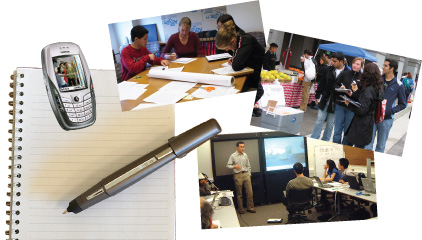
Two long-standing traditions in art and design education are the Idea Log, also known as a design notebook or research notebook, where students keep track of all their design ideas; and the studio critique, where students display work-in-progress on the wall and present it to groups of people in class. Today, these design activities primarily involve physical artifacts. We believe that there is significant potential for further integrating technology into design activities and education, from sharing ideas among classmates and teachers to improving education for future students by allowing them to study work from previous courses. The iDeas learning ecology integrates digital notebooks, blogs, walls, and other technologies into existing design practices, allowing designers to take advantage of affordances in the digital world while preserving advantages of the physical world. |
|
|
Wendy Ju, Brian Lee, Scott R. Klemmer. Range: Exploring Implicit Interaction through Electronic Whiteboard Design. CSCW 2008. Heidy Maldonado, Brian Lee, Scott R. Klemmer, Roy D. Pea. Patterns of Collaboration in Design Courses: Team dynamics affect technology appropriation, artifact creation, and course performance. In Proceedings of CSCL 2007. Brian Lee, Heidy Maldonado, Scott R. Klemmer, Isabelle Kim, Paz Hilfinger-Pardo. Longitudinal Studies of Augmented Notebook Usage Informing the Design of Sharing Mechanisms. Stanford University Computer Science Department Technical Report, CSTR 2006-11, 2006. Brian Lee. From Cognitive Artifacts to Social Artifacts: The iDeas Design Ecology. In Conference Supplement to UIST 2006: ACM Symposium on User Interface Software and Technology. (Doctoral Symposium) Heidy Maldonado, Brian Lee, Scott R. Klemmer. Technology for Design Education: A Case Study. In Extended Abstracts of CHI 2006: ACM Conference on Human Factors in Computing Systems. (Work-in-Progress) |
|
All source code is available as open source under the BSD license. ButterflyNet is being developed as part of the Field Tools code base. Check out the Java J2SE 5.0 source code using Subversion:
svn://hcisource.stanford.edu/FieldTools/ButterflyNet/trunk (main codebase) |
|
|
Brian Lee This project is a collaboration with the IT University of Göteborg. |
|
| FAQ | The FAQ has answers to some frequently asked questions about installation, software/hardware, and the project in general. Please read! |
|
Brian Lee (balee at cs dot stanford dot edu) |